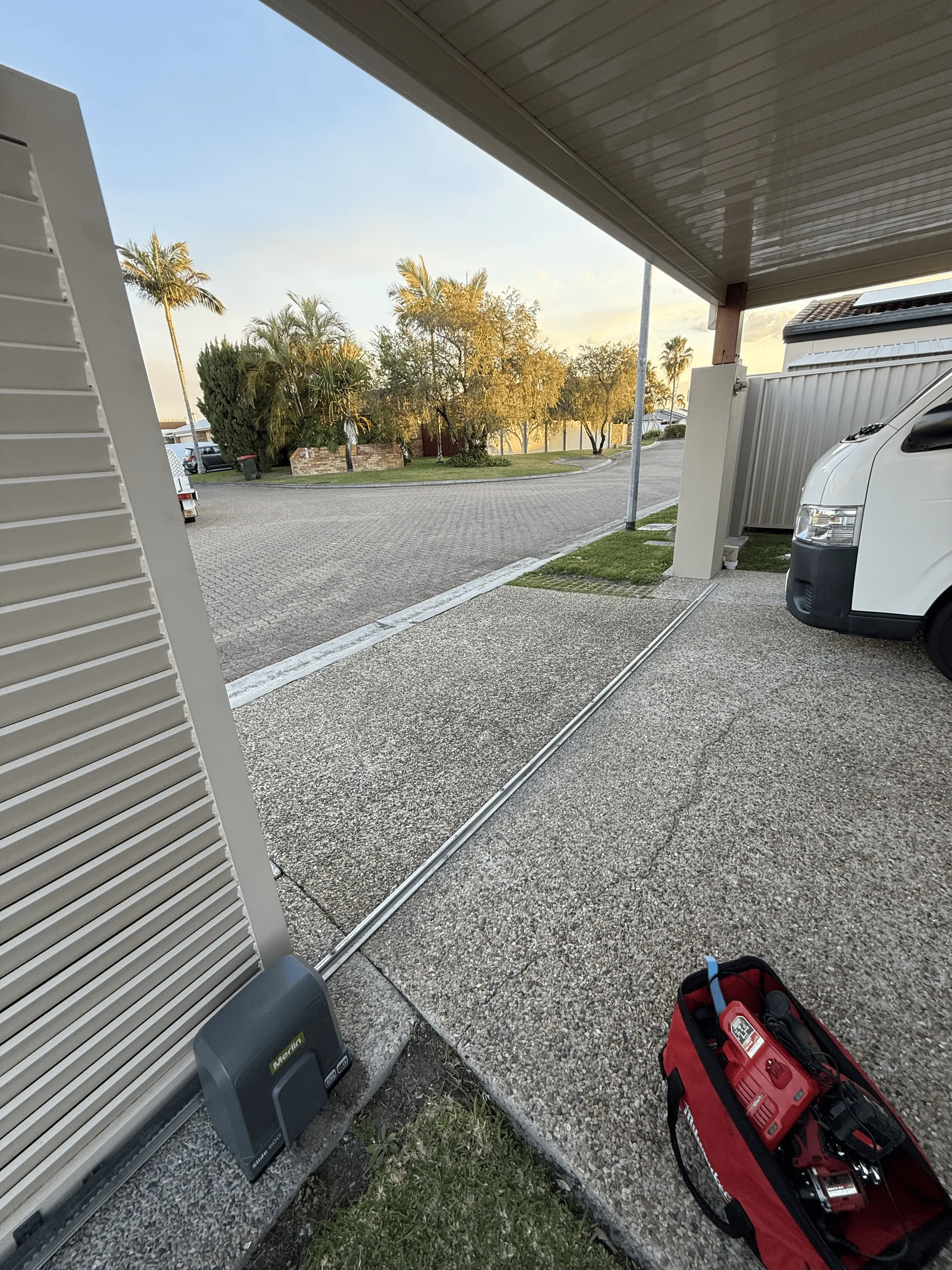
A sliding gate that won't move is one of those problems that always seems to happen at the worst time — you're leaving for work, a delivery's waiting, or the gate's stuck wide open overnight. Before you assume the worst, it's worth knowing that most sliding gate faults come down to a short list of causes, and a fair few of them are things you can safely check yourself in a couple of minutes.
This guide is written for Gold Coast homeowners, but it applies just as well to strata and body corporate gates, and commercial properties running automatic sliding gates day in, day out.
What the Problem Looks Like
A few common patterns, and they usually point in different directions:
- The gate doesn't respond at all — no motor sound, no lights, nothing happens when you press the remote or wall button.
- The motor runs (you can hear it) but the gate doesn't move.
- The gate opens fine but won't close, or stops partway through closing and reverses.
- The gate moves, but only partway, then stops.
- The remote works some of the time but not reliably.
It's worth noting exactly what your gate is doing before you call for help — it saves time on-site and often means a technician arrives with the right part already on the van.
Most Common Causes
Power Supply Issues
Automatic gates run off mains power, often backed up by a battery so the gate still works during a blackout. If there's been a power outage, a tripped circuit breaker, or the backup battery has quietly worn out, the gate simply won't have the power it needs. This is one of the most common causes of a completely unresponsive gate, and one of the easiest to check yourself.
A Flat or Out-of-Sync Remote
If the gate has power but nothing happens when you press the remote, the transmitter battery is the first thing to suspect. Remotes can also lose their programming after certain power interruptions or control board resets, which is a technician job to re-sync.
Safety Sensor (Photocell) Faults
Many automatic gates include photoelectric safety sensors as part of the installation, positioned to detect anything in the gate's path. If something blocks the beam — a plant that's grown into the way, cobwebs, dirt on the lens, or even strong sun hitting the sensor at a certain angle — the gate can refuse to close, or reverse if it's already closing. On a gate fitted with this kind of sensor, that's not really a fault; it's the safety system doing what it's meant to do. It just doesn't feel that way when you're standing in the driveway wondering why the gate won't shut.
Limit Switch or Encoder Problems
The motor needs to know where "fully open" and "fully closed" actually are. If the limit switch or encoder that tracks this has slipped, failed, or lost its setting, the gate can stop short, refuse to start moving because it thinks it's already at the limit, or grind against the end of its travel. This is a control-board-level fault and needs a technician to diagnose and reset properly.
The Manual Release Was Left Disengaged
Most gate motors have a manual release or clutch so the gate can be pushed by hand during a power outage. If it's been used and not switched back to automatic, the motor will run perfectly normally — you'll hear it — but it's not actually connected to the gate, so nothing moves. This is a genuinely common and easy fix once you know to check it.
A few other causes worth ruling out: something physically sitting in the track (sand, gravel, a branch, even a toy), and storm or lightning damage — after severe weather, a tripped circuit, a blown fuse, or genuine control board damage from a power surge are all common causes of a gate that suddenly stops working with no obvious mechanical cause.
Checks You Can Safely Perform
- Check power at the isolator switch or the GPO the gate motor is plugged into, and check the relevant circuit breaker hasn't tripped.
- Try a fresh battery in the remote, and try a second remote or keypad if you have one — this quickly tells you if it's the remote or the gate.
- Have a look at the safety sensors (small boxes usually mounted low, facing each other across the gate opening, if your gate has them). Check for anything obviously blocking the beam or built-up dirt on the lens, and gently wipe the lens clean if needed. Don't open the sensor housing or touch any wiring.
- Check the track for anything sitting in it — sand, gravel, leaves, a stray toy — and clear it if it's safe and easy to reach.
- Check the position of the manual release lever against what you'd normally expect to see when the gate is running automatically.
- If the motor beeps or flashes a light pattern when you try to operate the gate, take a note (or a quick video) of it — this is genuinely useful information for whoever comes out, since beep and flash codes vary between motor brands.
When to Stop Troubleshooting
Stop and call a technician straight away — don't keep pressing buttons or trying to force anything — if the gate moves erratically, jerks or reverses unexpectedly without an obvious obstruction; the motor sounds like it's straining or grinding, or you can smell anything hot or burning; you notice sparking, exposed wiring or visible damage to the motor or control box; the gate looks unstable; or there's any risk to children, pets or vehicles while the gate is behaving unpredictably. If it's safe to do so, isolate power at the switch and leave the gate in manual mode until someone can look at it properly.
When to Call a Gate Technician
Anything beyond the checks above is genuinely a job for a professional — not because the checks above are token gestures, but because the next layer of diagnosis involves the control board, wiring and safety systems, and getting any of that wrong on a gate isn't worth the risk. Call a technician for control board or motor diagnosis, sensor realignment or rewiring, limit switch or encoder resetting and reprogramming, backup battery replacement, and anything following storm or lightning damage.
If you're on the Gold Coast and your sliding gate has stopped working, Fortex Door Services diagnoses and repairs gate motors, remotes, sensors and control boards on-site, with a clear quote before any work starts. See our gate motor repair service for what's covered, or call 0434 099 873and we'll talk through what your gate's doing before we book a visit.
How the Issue Can Be Prevented
A yearly service — checking the backup battery, sensor alignment and limit switch settings — catches most of these faults before they leave you locked in or locked out. Keeping the track clear of debris, not forcing the gate by hand while it's in automatic mode, and addressing small issues (a slight beep, a hesitation before moving) early rather than waiting for a full failure will save you an emergency call-out down the track. If your gate keeps coming off its track rather than just stalling electrically, that's a different, more mechanical problem — see our guide to sliding gates that have derailed.
Frequently Asked Questions
Why does my sliding gate open but won't close?
This is very often a safety sensor issue — many gate motors are set up to refuse to close (or to reverse) if the photocell beam between the sensors is blocked or misaligned. Check for anything obstructing the sensors first. If that's not it, it may be a limit switch problem and worth a technician visit.
My gate motor keeps beeping — what does that mean?
Most gate motor brands use a beep pattern to signal a fault, but the codes differ between brands. Note the pattern (how many beeps, how often) and mention it when you call — it helps narrow down the fault before a technician even arrives.
Is it safe to manually push my sliding gate open?
Only if the motor's manual release or clutch has been properly disengaged first. Forcing a gate that's still engaged with the motor can damage the gearbox or drive mechanism. If in doubt, don't force it — call a technician.
How much does sliding gate repair cost on the Gold Coast?
It depends on the fault — a remote reprogram is a very different job to a control board replacement. We give you a clear quote on-site before any work begins, so there's no obligation and no surprises.
Can rain or storms stop my gate working?
Yes — heavy rain can affect sensor performance, and storms or lightning can trip breakers or damage control boards outright. If your gate stops working after severe weather, it's worth a professional check even if it seems to come good on its own.