Garage Door Motor Not Working?Diagnose It in 5 Minutes
Work through the six most common motor symptoms below — what causes each one, which checks are safe to try yourself, and the point where it becomes a technician's job.
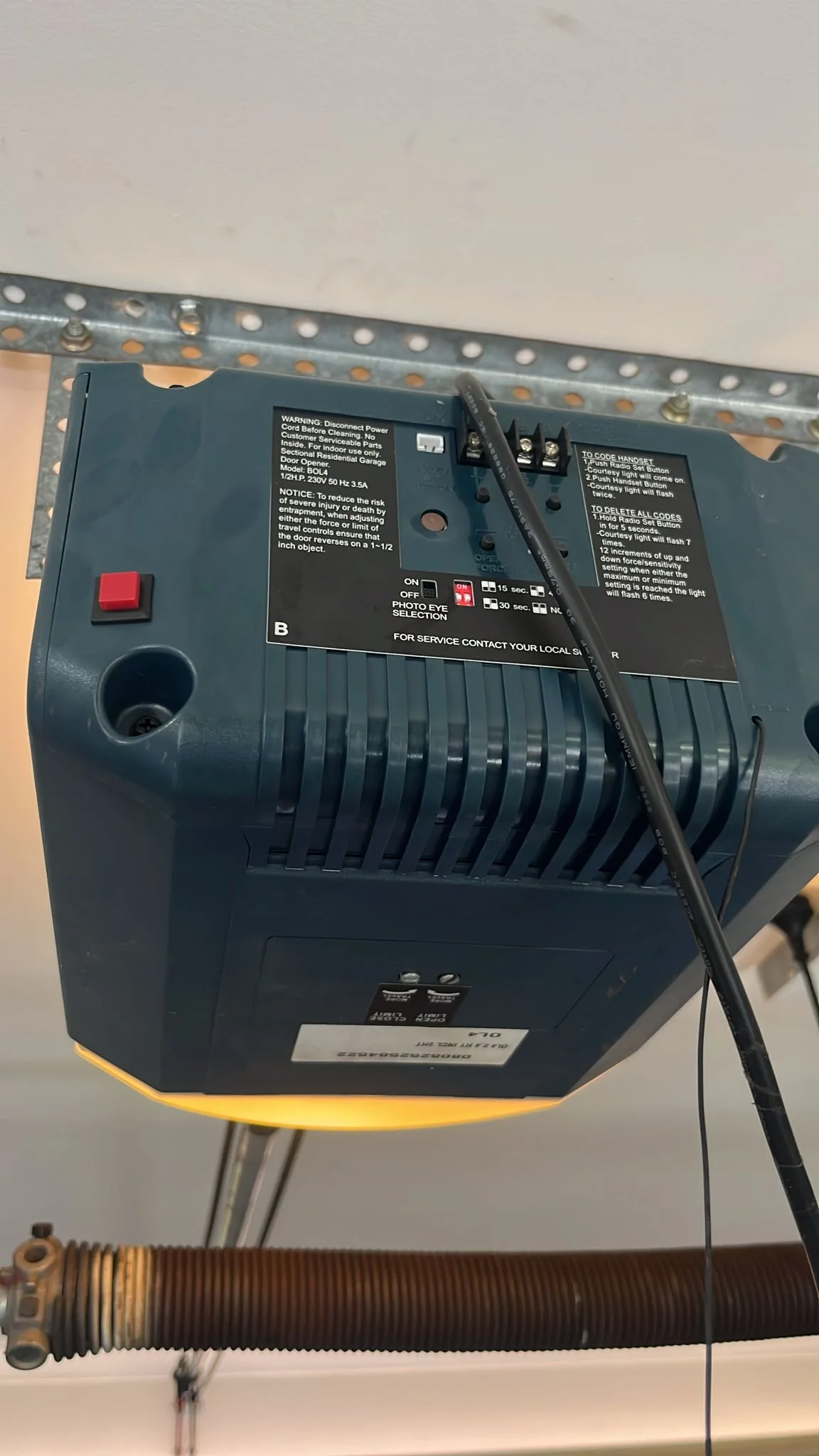
Symptom-by-Symptom Troubleshooting
Find your symptom, try the safe check, and you'll know within minutes whether it's a two-dollar battery or a technician call.
Motor hums but the door doesn't move
Likely cause
Usually a stripped drive gear inside the motor unit, a disengaged trolley (someone pulled the red release cord), or a seized capacitor that can't deliver starting torque.
Safe DIY check
Look up at the rail while pressing the button. If the chain or belt moves but the door doesn't, the trolley is disengaged — run the door to the closed position and it usually re-clips. If nothing on the rail moves at all, stop there.
When to call a pro
Humming with no movement after re-engaging the trolley means internal gear or capacitor failure — both are workshop-level repairs.
Remote works but the wall button doesn't (or vice versa)
Likely cause
These run on separate circuits, which makes this fault easy to isolate. Wall button dead = broken wire or button unit. Remote dead = flat battery, lost pairing, or a failed receiver board.
Safe DIY check
Swap the remote battery first — it fixes more "broken motors" than anything else we see. If the wall button is the dead one, check the thin bell wire running from the button to the motor head for visible damage.
When to call a pro
If a fresh battery and re-pairing (see your motor's learn button) don't bring a remote back, the receiver board is suspect — a component-level fix.
Door starts closing, then reverses immediately
Likely cause
Nine times out of ten it's the safety beams — misaligned, dirty, or interrupted. Otherwise the down-force limit is set too sensitively and trips on normal rolling resistance.
Safe DIY check
Find the two small sensors near the floor on each side of the opening. Wipe the lenses and check both indicator lights are solid, not blinking. Move anything leaning against the tracks — a broom handle in the beam path is a classic.
When to call a pro
If the beams show solid lights and the door still reverses, the travel and force limits need recalibrating — get it done professionally, because disabling safety reversal to "fix" it is dangerous.
Motor runs but the door is slow, jerky or strains
Likely cause
This is usually not a motor fault at all. A door that's lost its spring balance makes the motor drag the full door weight — the strain you hear is the motor working far beyond its rating.
Safe DIY check
With the door closed, pull the manual release and lift the door halfway by hand. A balanced door stays put; a door that slams down or flies up has a spring problem, not a motor problem.
When to call a pro
Spring tension is not a DIY job under any circumstances. If the balance test fails, stop using the opener — every cycle shortens the motor's life — and have the springs adjusted or replaced.
Complete silence — no response at all
Likely cause
Power supply, tripped safety switch, blown fuse in the motor head, or a dead logic board — common on the coast, where salt corrosion eats circuit board tracks.
Safe DIY check
Check the motor's power point with another appliance, then your switchboard for a tripped breaker. Look for any light on the motor head — some standby light means power is arriving and the fault is internal.
When to call a pro
Power confirmed at the socket but the unit stays dark? That's a logic board or transformer failure. Depending on the motor's age it's a board swap or a full replacement — we'll quote both options.
Light on the motor unit blinking a pattern
Likely cause
Most brands blink error codes. On common Merlin and B&D units, repeated blink patterns typically point to safety beam faults, travel limit errors, or RF interference — the manual maps the exact code.
Safe DIY check
Count the blinks between pauses and check the code against your model's manual (most are downloadable by model number from the brand's site). Beam-fault codes you can often clear by cleaning and realigning the sensors yourself.
When to call a pro
Codes pointing at the logic board, motor overheating or position memory need a technician — clearing them without fixing the cause just brings them back.
Safety rule of thumb: anything involving springs, cables under tension, or opening the motor housing is off-limits for DIY. Batteries, sensor lenses, the manual release cord and the switchboard are the safe zone.
Why Gold Coast Motors Fail Differently
Two local factors show up in our motor call-outs again and again.
Salt air and humidity vs circuit boards
Within a couple of kilometres of the beach, salt-laden air gets inside motor housings and slowly corrodes logic board tracks and relay contacts. The result is the classic coastal failure pattern: intermittent faults that get worse over months — a door that occasionally ignores the remote, then regularly, then always.
In suburbs like Mermaid Beach, Miami and Palm Beach we see logic boards fail years earlier than the same models installed inland. If your coastal motor is behaving erratically rather than dying outright, corrosion is the first thing we check.
Storm-season power surges
Every summer storm season brings a spike in dead motors. Garage door openers are permanently plugged in and rarely surge-protected, so grid surges from nearby lightning strikes hit their logic boards first. The telltale sign: the door worked before the storm, and afterwards it's dead or has lost its remote pairing and travel limits.
Surge-damaged boards almost always look untouched from the outside — the damage is electrical, not visible. A $20 surge protector on the motor's power point is cheap insurance, and if the failure followed a storm, check whether your home insurance covers electrical surge damage.
Diagnosed it — now what?
- Under ~7 years old with a single failed component (capacitor, receiver, sensors): usually worth repairing.
- Over 10 years old, or a failed logic board on a discontinued model: replacement is normally cheaper than chasing parts.
- Motor straining because the door itself is out of balance: fix the door first — a new motor will burn out the same way.
For brands, models and installation details, see our garage door motor installation & replacement service — this page stays focused on working out what's wrong.
Motor Troubleshooting FAQs
How do I open my garage door during a power outage?
Every motor has a manual release — usually a red cord hanging from the trolley on the rail. Pull it while the door is fully closed and the door disconnects from the motor so you can lift it by hand. Never pull the release while the door is open: if the springs are worn, the door can fall. After power returns, most doors re-engage by running the motor through one full cycle.
How can I tell if the fault is my remote or the motor unit itself?
Use the wall button as the tiebreaker. If the wall button operates the door but the remote doesn't, the problem is the remote (battery, pairing) or the receiver. If neither works, the fault is in the motor unit or its power supply. If the remote works only from very close range, that points to a failing receiver board or aerial rather than the remote.
What are the symptoms of a failed capacitor in a garage door motor?
A humming motor that won't actually drive the door, a motor that needs a "nudge" to start, or one that starts intermittently — especially on cold mornings — are classic capacitor symptoms. The capacitor delivers the surge of torque the motor needs to start moving. It's a cheap component, but it stores charge even when unplugged, so replacement is not a safe DIY repair.
How do I know if a storm or power surge damaged my motor?
The typical pattern: the door worked before the storm and is completely dead or behaving erratically afterwards — random opening, lost remote pairing, or a dark control panel while the power point tests fine. Gold Coast summer storms send surges through the grid that logic boards handle poorly. If you suspect surge damage, note the storm date — some home insurance policies cover electrical surge damage to fixed appliances like garage door openers.
Stuck on the Diagnosis?
Tell us the symptom over the phone — we can often tell you what you're dealing with before we arrive. Same-day service across the Gold Coast.