Not sure if your motor needs repair or replacement?
Fortex can inspect the door and motor together — we quote before we start and won't recommend replacement if a repair makes more sense.
Call 0434 099 873When your garage door motor stops working, the instinct is to assume the motor is the problem. Sometimes it is. But the most common reason a motor fails — or appears to fail — is that it's been working against a door that's become too hard to move: a broken spring, worn rollers, a dry track, or a door that's come off its hinges. Replace the motor without fixing the door, and the new motor faces the same problem.
This guide covers the specific symptoms a failing motor produces, what each one likely means, and the honest repair-vs-replace decision for Gold Coast homeowners. For our full motor service, see the garage door motors page.
Check the Door Before the Motor
Before diagnosing the motor, disconnect it via the red emergency release cord and try lifting the door by hand. A correctly balanced door should open smoothly and stay at half-height without drifting up or down. If:
Diagnose by Symptom
Symptom 1
Motor clicks but door doesn't move
Likely: Broken spring or stripped drive gear
A click means the motor received the signal and tried to engage — but couldn't. If the door feels heavy when you try to lift it manually, a spring has broken and the motor has been working against the full door weight (80–120 kg unassisted). This strips the drive gear quickly. If the door lifts easily by hand, the drive gear itself has stripped and the motor is spinning freely without transmitting force.
What to do: Stop pressing the remote — you're burning out the motor. Disconnect it via the red release cord and call. Both causes are fixable same-day.
Symptom 2
Motor light flashing — door won't move
Likely: Sensor fault, limit error, or overload
Modern motors use flash codes to communicate faults. Count the flashes before and after the pause — that's your diagnostic code. A sensor fault (most common) means the safety beam between the two sensors near the floor is interrupted or the sensors are misaligned. An overload trip means the motor got too hot and shut itself off — let it cool for 30 minutes and try again.
What to do: Check both sensor lenses: clean them, confirm nothing is blocking the beam, and make sure they're aligned. If the sensors look fine, call and describe the flash pattern.
Symptom 3
Remote works sometimes, not others
Likely: Weak battery, interference, or antenna issue
Intermittent remote failure is almost always the battery getting too low to reliably transmit — even if the remote's LED still lights up. A fresh battery resolves this in most cases. If it continues after a new battery: the remote may need reprogramming, there may be RF interference from a new device nearby (some LED lights, solar inverters), or the motor's antenna wire has come loose.
What to do: Replace the battery first. If the problem persists after a new battery, call for a reprogramming visit — usually a quick, low-cost job.
Symptom 4
Door opens halfway then stops and reverses
Likely: Limit setting, obstruction detection, or spring tension issue
The motor is designed to reverse if it senses resistance mid-travel — a safety feature to prevent it trapping people or objects. Causes: the down-force or up-force limit is set too sensitive, a roller or track is creating friction at that point in the travel, or the spring tension is uneven so the door becomes harder to move at a specific point. Debris in the tracks or a bent section can also cause this.
What to do: Run the door slowly and watch for the point where it starts to resist. Check for visible track damage or debris at that height. If nothing obvious, the force limits need adjustment — a technician job.
Symptom 5
Chain or belt is slack, hanging down
Likely: Chain/belt needs tensioning or has snapped
Chain-drive motors have a tensioning adjustment on the drive rail. A slightly slack chain causes jerky operation and excess noise but won't stop the motor from working. A very loose chain can jump the sprocket entirely, in which case the motor runs but the door doesn't move. Belt-drive motors are less prone to stretching but the belt can fray and eventually snap.
What to do: A slack chain is adjustable. Don't over-tighten — a small amount of sag is normal. If the chain has jumped or the belt has snapped, call for repair.
Symptom 6
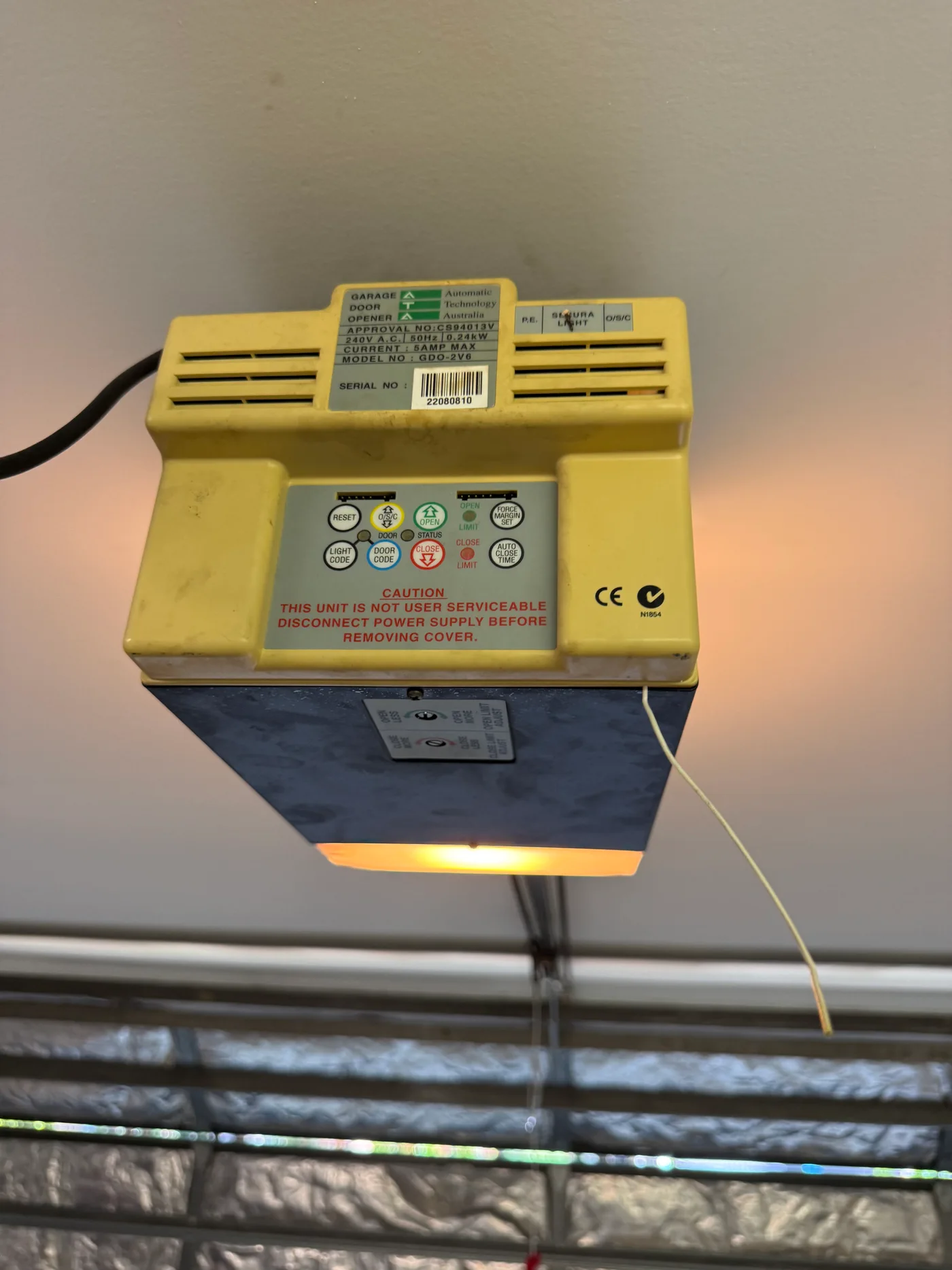
Motor is old — Merlin, B&D, ATA from 10+ years ago
Likely: End of service life — assess before deciding
Older motors can still be repaired — parts for B&D, Merlin, and ATA units are generally available. But a motor that's 12+ years old and already failing has likely given most of its service life. The question to ask: is this the first problem, or is it becoming a recurring one? One repair on a 12-year-old motor that's been well-maintained is reasonable. Third repair in three years on a 14-year-old unit — replacement is the better investment.
What to do: We'll inspect the motor and the door and give you an honest assessment. We don't replace motors unnecessarily — if a repair makes sense, we'll say so.
When Service Is Enough vs When to Replace
Service or repair makes sense
- ✓Motor is less than 10 years old
- ✓First or second fault — not a pattern of failures
- ✓Fault is a component: drive gear, sensor, limit board
- ✓Motor is a quality brand (B&D, Merlin, Steel-Line)
- ✓Repair cost is under 40% of a new installed motor
- ✓Door itself is in good condition and well-balanced
Replacement makes more sense
- ✗Motor is 12+ years old and failing repeatedly
- ✗Parts are discontinued or very expensive to source
- ✗Repair cost approaches or exceeds 50% of a new motor
- ✗Motor lacks modern safety features (no auto-reverse)
- ✗Customer wants app control or battery backup
- ✗Motor has been running against a broken spring — internal wear is likely extensive
Why we inspect the door and motor together
A motor working against a broken spring will strip its drive gears within days or weeks. A motor on an unbalanced door runs at higher than rated load every cycle — shortening its lifespan significantly. When you call Fortex, we check the spring tension, roller condition, track alignment, and cable state as part of every motor fault call. That way the fix addresses the actual cause, not just the symptom you noticed. If the door needs attention before the motor, we tell you — because fitting a new motor to a bad door wastes your money.
Garage Door Motor Not Working When It's Cold?
If your garage door motor only struggles on cold mornings, the motor may not be the only issue. A balanced garage door should not rely on the opener to force the full weight of the door. Cold weather often reveals an existing problem with spring tension, door balance, rollers, tracks, or an ageing motor — rather than causing a new one.
On the Gold Coast, winter mornings are mild by most standards, but even a drop to 10–14°C is enough to stiffen old grease, reduce spring tension slightly, and expose a motor that was already working close to its limit. If the same door runs fine by mid-morning, the problem is load-related, not electrical.
Common symptoms on cold mornings
What cold weather is actually exposing
Old or weak motor under load
A motor nearing the end of its service life may manage a well-balanced door on warm days but lack the torque to overcome added friction in the cold.
Door out of balance
Springs that have lost tension leave the opener carrying more of the door's weight. Cold makes this worse, but the imbalance is the underlying problem.
Springs near failure or losing tension
Torsion springs lose a small amount of tension over time. A spring that's close to needing replacement will be noticeably weaker on cold mornings when the door is at its stiffest.
Stiff rollers, hinges, or guides
Old grease thickens significantly in cooler temperatures. Rollers or hinges that run dry or have degraded lubrication create real resistance that the motor has to overcome on every cycle.
Tracks need servicing
Accumulated dust, grit, and old grease in the tracks increase drag. A door that feels smooth in summer can feel noticeably stiffer in winter if tracks haven't been serviced.
Safety limits or force settings being triggered
If the motor's force settings are borderline, added cold-weather friction tips the door over the threshold and the motor reverses as a safety measure.
Drive system under strain
On chain-drive and belt-drive motors, added door resistance puts greater strain on the chain, belt, or drive gear — accelerating wear on components already in marginal condition.
If the door stops halfway or the motor is straining — stop.
Do not keep pressing the remote or wall button. Forcing an opener against a heavy door strips the drive gear, puts dangerous load on the cables and springs, and can cause the door to drop. The motor reversing is a safety response — treat it as a warning, not an obstacle to push through.
What you can check first (safe checks only)
Check the remote battery
A weak battery can cause exactly this symptom — intermittent failure that clears up as the opener warms up.
Check power to the opener
Confirm the motor unit is powered. Check the circuit breaker if neither the remote nor wall button produces any response.
Try the wall button
If the wall button works but the remote doesn't, the remote is the problem. If neither works, it's motor power or the motor itself.
Look for anything blocking the door
Check both sensor lenses near the floor are clean and unobstructed. The motor will reverse if the beam is broken.
Listen to the motor
Note whether it hums, clicks, grinds, or is completely silent. Each tells a different story — this helps a technician diagnose the fault quickly.
Do not manually disengage or lift the door if it feels unusually heavy or behaves unpredictably. If the spring is broken or the door is unstable, manual operation without knowing the cause is a safety risk.
Garage door motor struggling on cold mornings?
Fortex can inspect the opener, door balance, spring tension, tracks, rollers, and moving parts to find the real cause — not just the symptom that showed up this morning. Garage door repairs across the Gold Coast · garage door servicing · emergency repairs.
Call 0434 099 873Frequently Asked Questions
My garage door motor clicks once then goes quiet. What does that mean?
A single click followed by silence usually means the motor is receiving the signal but can't engage. Common causes: a broken spring making the door too heavy to lift, a seized or stripped drive gear, or a motor thermal overload that has tripped after overheating. If the door feels very heavy manually, it's almost certainly a broken spring — and the motor has been clicking against a load it can't shift.
The motor light is flashing — what does that mean?
The flash count is a diagnostic code specific to the brand and model. Count the flashes (e.g. 5 flashes pause 5 flashes) and check the manual or the label on the motor housing. Common meanings include: sensor fault (2–3 flashes on most B&D and Merlin units), limit setting error, or overload. If you can't identify the code, call us and describe the pattern.
Should I replace the motor before getting the door checked?
No. This is one of the most common and most expensive mistakes. If the door is unbalanced — because of a broken spring or worn rollers — the new motor will work against the same resistance the old one did. It will either fail early or cause the same symptoms. Always inspect and balance the door first.
How long do garage door motors last on the Gold Coast?
With annual servicing, quality motors (B&D, Merlin, Steel-Line) typically last 12–15 years. Salt air and humidity accelerate corrosion on electrical components, so Gold Coast motors at the lower end of that range benefit from inspection after 10 years. Budget-brand motors often last 6–10 years.
Why does my garage door motor stop working when it's cold?
Cold weather can make an existing issue more noticeable. The motor may be weak, the door may be out of balance, the springs may be losing tension, or the rollers and tracks may need servicing. Old lubricant also stiffens in cold temperatures, adding load to the opener. A technician should check the door and opener together rather than assuming the motor is the only problem.
Why does my garage door open later in the day but not in the morning?
On cold mornings, stiff moving parts and poor door balance increase the load on the opener. As temperatures rise through the day, grease softens, metal expands slightly, and the door becomes easier to move — so the same motor that struggled at 7am manages fine by midday. If this is happening regularly, the door likely needs servicing or the motor is underpowered for the door's current condition.
Should I replace my garage door motor if it only struggles in winter?
Not until the door has been inspected. A motor that fails only on cold mornings is often working against a door that's out of balance, has stiff rollers, or has springs that are losing tension. Servicing and rebalancing the door may resolve the problem without replacing the motor. If the motor is also old, replacement may make sense — but the door needs attention either way.
Is it safe to keep using the motor if the door stops halfway?
No. If the door stops halfway, feels unusually heavy, or the motor is clearly straining, stop using the opener immediately and call a technician. Forcing the door can strip the motor's drive gears, damage cables, put extra stress on the springs, or cause the door to drop. The safety reversal is a warning — treat it as one.