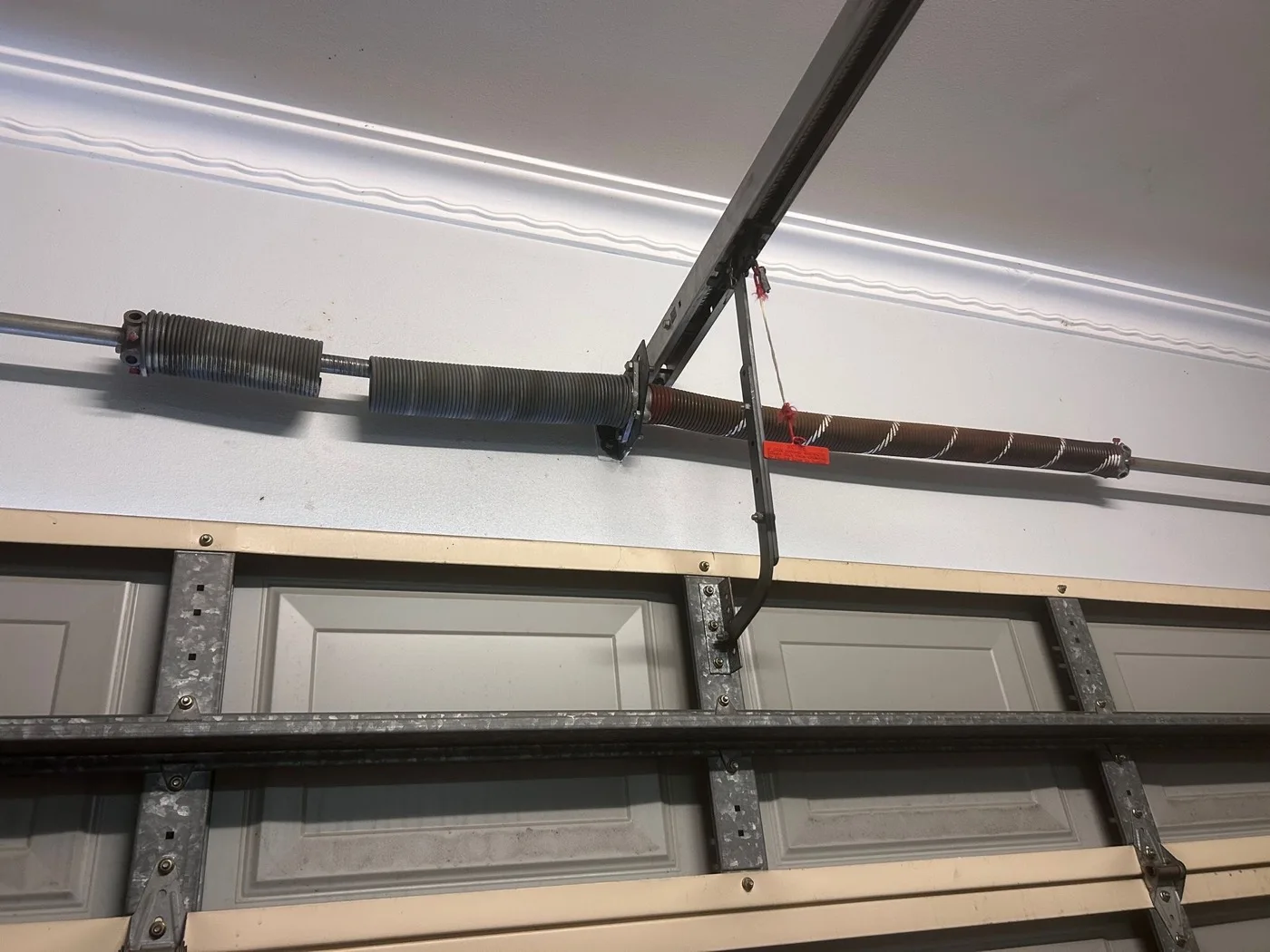
Most homeowners only think about their garage door spring the moment it fails — a loud bang, a door that suddenly won't budge, a car trapped inside. But a spring rarely goes from perfect to broken overnight. It fatigues gradually, and that gradual decline usually leaves clues long before anything actually snaps. Knowing what to look for is the difference between booking a garage door spring replacement at a convenient time and dealing with an emergency call-out on a Monday morning.
What Your Garage Door Springs Actually Do
Every sectional or roller garage door relies on a counterbalance system to make a heavy door manageable. The spring — or springs — store mechanical energy and release it as the door opens, carrying most of the door's actual weight. Cables running from the bottom corners of the door to cable drums on the torsion shaft transfer that stored energy into lifting force.
This matters because your garage door opener was never designed to lift the door's full dead weight on its own. A motor is sized to guide a correctly balanced door along its tracks — nudging it up and down with the springs doing the heavy lifting. That's why a well-balanced door, disconnected from its opener, can usually be lifted with one hand and will stay roughly where you leave it. When the spring system is doing its job, the motor barely notices the door is there.
Rollers, hinges, tracks and bearings all play supporting roles too, guiding the door smoothly through its travel. But the spring is what makes a 100 kg-plus door feel light. Once it starts losing tension, everything downstream of it — the cables, the opener, the tracks — starts absorbing load it wasn't designed to carry.
Springs Are Wear Components, Not Fixed Parts
A garage door spring is engineered to withstand a certain number of cycles — one cycle being a single full open-and-close of the door — before metal fatigue makes failure likely. Unlike a bracket or a track, which will generally last as long as the door itself if kept in good condition, a spring has a working life measured in use, not just years.
There isn't a single number that applies to every door. How long a given spring actually lasts depends on a combination of factors:
- The spring's specification and cycle rating
- The weight of the door it's supporting
- How many times a day the door is used
- Exposure to humidity and corrosion
- Whether it was correctly sized and installed in the first place
- How well it's been maintained and lubricated over time
We've written a more detailed breakdown of how long garage door springs typically last and how cycle ratings translate into years for different households, if you want the fuller picture.
What Happens as a Spring Gets Weaker
Spring failure is rarely instant. As tension is lost through fatigue or corrosion, the counterbalance system gradually stops doing its share of the work, and the effects show up in how the door behaves:
- The door loses its balance and no longer sits still when partway open
- It feels noticeably heavier when lifted or lowered manually
- The opener works harder and may sound strained or run slower than usual
- Movement becomes uneven, jerky, or hesitant rather than smooth
- Unusual creaking, groaning or popping noises appear during operation
- Cables, rollers and other hardware come under extra stress as they compensate
A homeowner will often notice the opener sounding different, or the door feeling heavier than it used to, well before realising it's the spring system deteriorating rather than the motor itself.
Warning Signs Your Garage Door Spring May Need Attention
Some symptoms point fairly clearly to the spring. Others could have a few different causes and are worth a second look before assuming the worst.
Strong indicators of a spring problem
- Door suddenly feels much heavier than usual
- Door won't stay balanced when manually opened partway
- Visible rust, pitting or corrosion on the spring coils
- A visible gap, stretch or deformation in the coil
- Door has clearly gone many years, or very heavy use, without attention
Signs worth checking, but not always the spring
- Motor appears to be struggling to lift the door
- Door rises unevenly or tilts to one side
- Unusual creaking, banging or grinding noises
- Door has needed repeated adjustment lately
- Movement has become slower or hesitant
That second list can just as easily point to a worn cable or drum, a misaligned track, or a roller that's had it. A technician checking door balance and spring condition together is generally more reliable than guessing from symptoms alone — an inspection can identify corrosion, loss of tension, and other developing problems without needing to predict the exact day something will let go.
What Happens When a Garage Door Spring Snaps
A snapped spring is inconvenient rather than catastrophic in most cases, but it does mean the door is out of action until it's replaced. Realistically, you can expect:
- The door becomes extremely heavy — often too heavy to lift safely by hand
- The opener may be unable to lift the door at all, or may stall partway
- A car parked inside can become trapped until repairs are done
- The door can get stuck in either the open or closed position
- Cables can come loose from their drums under the sudden change in tension
- Other hardware — tracks, rollers, brackets — can take unexpected load and be damaged
If this has already happened to you, our guide on a loud bang followed by a door that won't open walks through what to do next, and our broken spring page covers immediate next steps in more detail.
Why Replacing a Worn Spring Before It Snaps Can Make Sense
There's a reasonable argument for waiting until a spring actually fails — you get every last cycle out of it. But for most households, replacing a spring that's clearly on the way out has a few practical advantages:
- No unexpected breakdown: You choose when the work happens, rather than finding out at 7am when you're trying to get to work.
- Less strain on the opener: A weakening spring forces the motor to do more of the lifting than it was built for, which shortens its working life.
- Correct door balance maintained: A balanced door moves smoothly and puts less stress on cables, tracks and rollers.
- Related hardware gets checked too: A technician replacing a worn spring will typically look over the cables, drums and rollers at the same time, catching problems before they compound.
- You're not locked out of your own garage: A snapped spring can leave a car trapped inside — replacing proactively avoids that scenario entirely.
How Garage Door Servicing Helps Identify Spring Problems
A proper garage door service is where most spring problems get caught before they become urgent. While the exact checklist varies between technicians, a thorough service typically looks at:
General lubrication of springs, rollers, hinges and tracks is usually part of the visit too. The point of a service isn't just to fix what's already broken — it's to catch a spring that's starting to corrode, lose tension or develop a visible gap while replacement is still a scheduled job rather than an emergency one.
Should Both Garage Door Springs Be Replaced Together?
Most sectional garage doors use two torsion springs mounted side by side on the shaft above the door. When one fails, technicians will often recommend replacing both — not as a hard rule, but because springs installed at the same time and used under the same conditions tend to reach the end of their working life at roughly the same point. Fitting one new spring alongside one heavily fatigued spring means the door is being balanced by two components in very different condition, and the older one is often not far behind. It's a judgement call that depends on the age and history of both springs, and it's worth discussing with the technician doing the work rather than assuming it either way.
What Happens When You Book a Replacement
Once you call, the process is straightforward:
- Inspection: we check the spring, cables, drums and door balance together, not just the obvious fault.
- Quote: a firm price before any work starts.
- Safe removal: tension is released and the old spring removed with the correct tools.
- Installation: the correctly rated replacement spring is fitted.
- Balance and testing: tension is adjusted and the door tested through a full cycle.
- Lubrication: springs, rollers, hinges and tracks are serviced while we're there.
Most spring replacements take 30–60 minutes, and we carry common spring sizes for same-day service.
Can I Replace a Garage Door Spring Myself?
This isn't a DIY job
A wound torsion spring stores a substantial amount of mechanical energy — enough that releasing or adjusting it incorrectly can cause serious injury. Without the right winding bars, technique and experience, there's little margin for error. Garage door spring replacement should always be left to a professional.
We won't walk through the replacement process step by step here for that reason. If your spring has already failed or is showing signs of wear, the sensible move is to book professional spring replacement rather than attempt it yourself.
How Often Should a Garage Door Be Serviced?
For many residential garage doors, an annual professional inspection is a sensible preventative-maintenance interval. It gives a technician the chance to check spring tension and condition, door balance, and the general state of cables, rollers and tracks before small issues turn into breakdowns.
That said, a single yearly figure doesn't suit every household. Doors used multiple times a day, doors on commercial or rental properties, and doors on properties close to the ocean where salt-laden air accelerates corrosion may benefit from more frequent checks. Manufacturer guidance for your specific door and opener is also worth factoring in alongside how the door is actually used.
The Gold Coast Coastal Factor
Coastal environments are hard on unprotected steel. Salt-laden air and high humidity accelerate corrosion on garage door springs, cables and other hardware, and that effect is more pronounced the closer a property sits to the ocean. Homes in suburbs like Burleigh Heads, Palm Beach, Currumbin, Coolangatta and Mermaid Beach tend to see visible spring corrosion sooner than equivalent doors further inland around Robina, Varsity Lakes, Helensvale or Coomera.
It's not a reason for alarm — it's simply a factor worth accounting for when deciding how often to have a coastal-facing garage door checked, alongside how many times a day it's used across suburbs like Southport, Broadbeach and beyond.
When Should You Call a Technician?
As a practical guide, it's worth arranging an inspection if any of the following apply:
- The door feels noticeably heavier than it used to
- How the door moves has changed — slower, jerkier, or less smooth
- The motor seems to be struggling or straining
- The door rises or sits unevenly
- You can see corrosion, rust or damage on the spring
- A spring has already snapped
- You don't know when the door was last serviced
Any of these on their own is worth a call. None of them mean the sky is falling — but a spring that's showing its age rarely gets better on its own, and catching it early is almost always the easier path.
Fortex Door Services — Spring Replacement & Servicing, Gold Coast
If your garage door is feeling heavier, sounding different, or you simply can't remember the last time it was checked, Fortex Door Services inspects springs, cables, rollers, hinges, tracks, door balance and opener operation across the Gold Coast. We assess before we quote, so you know exactly what needs attention before any work begins.
Call 0434 099 873 to book an inspection, spring replacement or a routine garage door service, or if the door has already given way, our emergency repairs team can help.