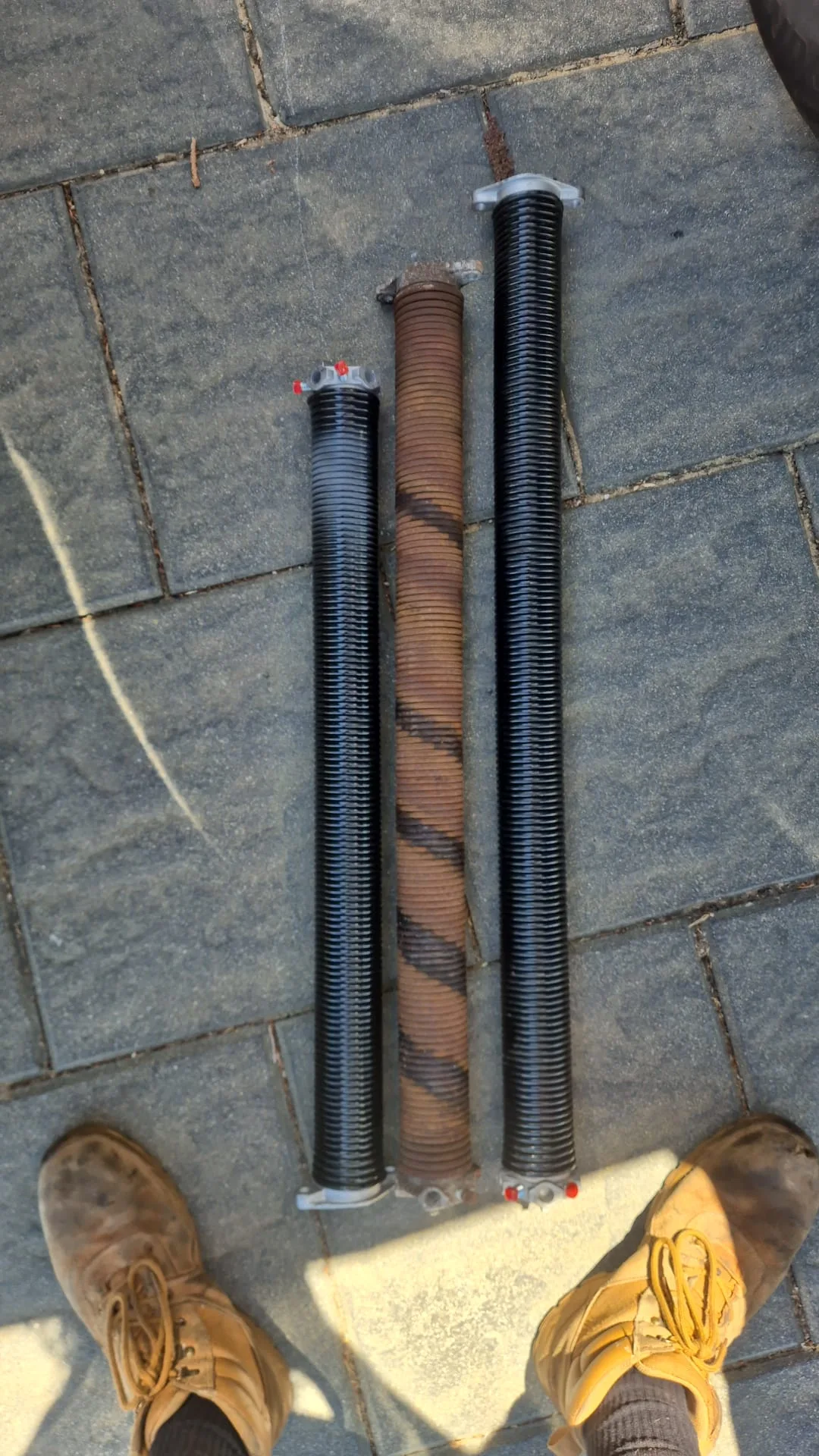
Garage door springs are the hardest-working components of your entire door system. They carry the full weight of the door every single time it opens and closes, and they do it thousands of times over their lifespan. Understanding how long they last — and what affects that — helps Gold Coast homeowners plan ahead rather than getting caught off guard by a sudden snap.
Springs Are Rated in Cycles, Not Years
The most important thing to understand about garage door springs is that manufacturers rate them by cycle count, not by time. One cycle equals one complete open-and-close sequence. Standard torsion springs — the type fitted to most Gold Coast homes — are typically rated for either 10,000 or 20,000 cycles depending on grade:
- Standard grade (10,000 cycles): Most builder-installed springs fall into this category. They're the base specification fitted during construction and are adequate for average use.
- High-cycle grade (20,000+ cycles): Heavy-duty springs suitable for garages that see above-average use — busy households, commercial properties, or large doors. These cost more upfront but significantly outlast standard springs.
- Ultra-high-cycle (50,000+ cycles): Commercial-grade springs used in industrial and high-frequency residential applications. Rarely specified for standard homes.
What That Means in Years for a Gold Coast Home
Converting cycles to years depends entirely on how often the door is used. Here's a realistic breakdown for typical Gold Coast households:
| Daily Cycles | Typical Household | 10,000-cycle spring | 20,000-cycle spring |
|---|---|---|---|
| 4 | One car, low use | ~7 years | ~14 years |
| 6 | Two cars, average use | ~5 years | ~9 years |
| 8–10 | Two cars, heavy use | ~3–4 years | ~6–7 years |
| 12+ | Multi-vehicle / business | ~2–3 years | ~4–5 years |
These figures assume ideal conditions. As we'll explain below, Gold Coast conditions can shorten these numbers considerably.
What Shortens Spring Life on the Gold Coast
Several factors specific to Gold Coast living can significantly reduce how long springs last:
- Salt air corrosion: This is the biggest factor for properties within a few kilometres of the coast. Salt in the air attacks the steel coils from the outside in, gradually weakening the spring's cross-section and making it more prone to fracture before it has exhausted its cycle rating. A spring near Surfers Paradise or Burleigh Heads can fail years ahead of an identical spring installed inland.
- Lack of lubrication: Springs need lubrication to cycle efficiently and reduce friction-related wear. Most Gold Coast homes have springs that have never been lubricated, which increases heat build-up and accelerates metal fatigue, particularly on frequently used doors.
- Incorrect spring sizing: A spring that is undersized for the door's actual weight carries more load than it was designed for on every cycle, shortening its useful life significantly. This is common on builder-installed springs where cost was the primary factor at fitting time.
- Temperature variation: Properties further inland near the hinterland, or in elevated areas like Highland Park and Worongary, experience larger day-night temperature swings than coastal suburbs. Metal expands and contracts with temperature, and repeated thermal cycling contributes to fatigue in older springs.
- Infrequent servicing: A spring that is starting to show rust or developing minor gaps in its coils can often be caught before it fails if the door is serviced periodically. Without servicing, small problems go unnoticed until the spring snaps.
The 7–10 Year Rule of Thumb
For a standard two-car Gold Coast household with builder-installed springs and average daily use, the practical rule of thumb is that springs need attention somewhere between seven and ten years after installation.
If your home is more than ten years old and the springs have never been replaced, they are statistically at elevated risk of failure. For coastal suburbs, reduce that estimate to five to eight years. Proactive replacement before a snap is significantly more convenient than dealing with a door stuck in the down position when you're trying to leave for work.
Signs Your Springs Are Getting Close to the End
Springs don't always snap without warning. These signs suggest yours are approaching failure:
- The door feels heavier than it used to when you try to lift it manually in balance test mode.
- The motor is running longer or sounding more strained on opening than it used to.
- You can see surface rust forming on the coils, especially near the ends.
- Small gaps are visible between coils when the door is in the closed position.
- The door jerks slightly rather than travelling smoothly when opening or closing.
- A creaking, groaning or popping sound during operation that wasn't there before.
Why We Always Replace Springs in Pairs
When one spring fails on a double-spring system, the instinct is to only replace the broken one. We always recommend replacing both. The reason is straightforward: if both springs were installed at the same time and the same conditions have acted on them, the remaining spring is just as close to the end of its life as the one that snapped. Replacing only the failed spring means you'll likely be dealing with the same job again in a matter of months — with another call-out fee, another inconvenience, and the same safety risk. Replacing both at once costs a little more upfront but avoids that scenario entirely.
Should You Upgrade to Higher-Cycle Springs?
When it comes time to replace your springs, it's worth considering whether standard or high-cycle springs are the better investment. For households that use the door frequently — a two-car family where both cars come and go multiple times a day — the additional cost of 20,000-cycle springs is usually recovered through longer service life and fewer replacement events over the door's lifetime. For households with a single vehicle and moderate use, standard springs are typically fine. We can advise on the right specification based on your actual usage pattern when we attend for a service or replacement job.