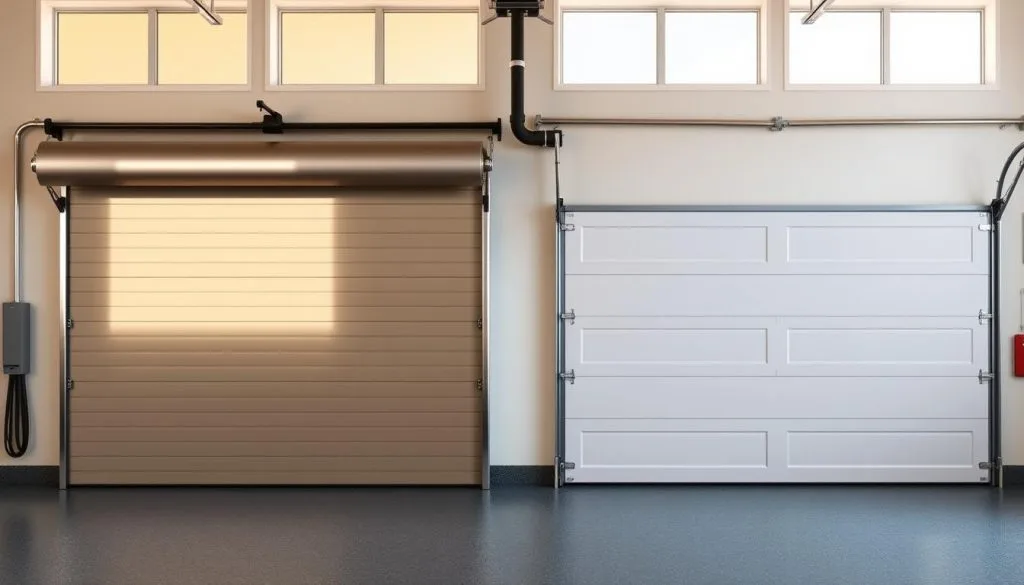
When you're replacing a garage door or fitting out a new build, the first fork in the road is door type: a roller door that coils into a drum above the opening, or a panel (sectional) door that travels up and back along ceiling tracks. Both are proven, both are made in Australia by the major brands — but they install differently, cost differently and suit different garages.
How Each Door Works
Roller Doors
A roller door is a single continuous curtain of corrugated Colorbond steel that wraps around a drum mounted above the opening. It rises vertically in narrow side guides, so it needs almost no ceiling space — but it does need 450–550mm of clear wall above the opening to house the rolled-up curtain.
Panel (Sectional) Doors
A panel door is made of four or five hinged horizontal panels that roll up and back along tracks fixed to the garage ceiling, balanced by a torsion spring above the opening. It needs less clearance above the opening than a roller door, but the ceiling area must stay clear for the tracks and the parked door.
What Each Installation Involves
A roller door installation is the simpler job: the drum brackets are fixed to the wall or piers above the opening, the guides are plumbed on each side, and the curtain is tensioned on the drum. A compact motor mounts directly on the axle.
A sectional installation has more parts: vertical and horizontal tracks, a torsion spring assembly that must be tensioned to match the door's exact weight, hinges, rollers and an overhead rail motor. It takes longer and there's more to get wrong — spring tension and track alignment in particular — which is why sectional doors are more sensitive to installation quality than roller doors.
Either way, a professional install includes removal of the old door, motor fitting and remote programming, and safety testing. See our new garage door installation service for how we handle the full process.
Side-by-Side Comparison
| Factor | Roller Door | Panel (Sectional) Door |
|---|---|---|
| Upfront cost | Lower — simpler door and install | Higher — panels, tracks, springs |
| Space needed | 450–550mm above opening; ceiling stays free | Clear ceiling space for tracks |
| Insulation & sealing | Limited — single steel curtain | Insulated panel options, better sealing |
| Looks & design range | Colorbond colours, corrugated profile | Wide range — profiles, timber-look, windows |
| Noise | Louder, can rattle in wind | Quieter, especially on a belt-drive motor |
| Motor type | Compact axle-mounted roller motor | Ceiling rail motor (belt or chain) |
Which Suits Which Property?
- Choose a roller door for garages with low or obstructed ceilings, carports and sheds, rental properties, and anywhere budget and simplicity matter more than looks.
- Choose a panel door for street-facing double garages on modern homes, garages attached to living areas (insulation and quiet operation pay off), and homes where the door is a major part of the facade.
- Check the opening first. Some garages physically rule one type out — not enough wall above the opening kills a roller door; ducting, storage lofts or low ceilings kill a sectional. A site measure settles it in minutes.
Still weighing up the two types on security, maintenance and running costs? Our earlier comparison of roller doors vs panel lift doors goes deeper on the ownership side.
Don't Forget Wind Rating
Gold Coast homes sit in a wind-rated region, and garage doors are the largest opening in the building envelope. Whichever type you choose, make sure the door is specified to the wind classification for your site — particularly on exposed or beachside blocks. A reputable installer will confirm this as part of the quote.
Pairing the Door With the Right Motor
The door type dictates the motor type. Roller doors take a compact motor mounted on the drum axle; sectional doors take an overhead motor on a ceiling rail, with belt-drive models the quiet choice for attached garages. Our guide to choosing the right garage door motor covers sizing and brands in detail.
If you're buying new, it's also worth choosing a motor with smartphone connectivity built in — current Merlin, B&D and ATA models support it, and it's much easier to set up at install time than to retrofit later. Here's how app control works and what you need.
Roller vs Panel Door FAQ
Which is cheaper to install — a roller door or a panel door?
A roller door is usually the cheaper option. The door itself costs less, the tracks are simpler, and installation is faster. A panel (sectional) door costs more upfront because of the panel construction, ceiling tracks and spring system, but offers better insulation, quieter operation and more design choice.
How much headroom does each door type need?
A roller door needs roughly 450–550mm of clear space above the opening for the rolled-up curtain and drum. A sectional door needs less above the opening but requires clear ceiling space for the horizontal tracks the panels travel along. A site measure confirms which fits your garage.
Can I put windows or insulation in a roller door?
Not really — a roller door is a continuous corrugated steel curtain, so windows and thick insulation aren't practical. Sectional doors accept insulated panels, window inserts and a wide range of finishes, which is why they dominate street-facing installations on modern homes.
How long does a new garage door installation take?
Once the door has arrived, most residential installations — roller or sectional — are completed in a single day, including motor fitting, remote programming and old door removal. Lead time on ordering the door is typically 1–3 weeks depending on brand and stock.